
What You Been Cooking?
In business, when two companies are offering a similar level of quality, service and experience, winning the sale can sometimes come down to one final ingredient: price.
But what if you could become more competitive without automatically cutting your advertised prices?
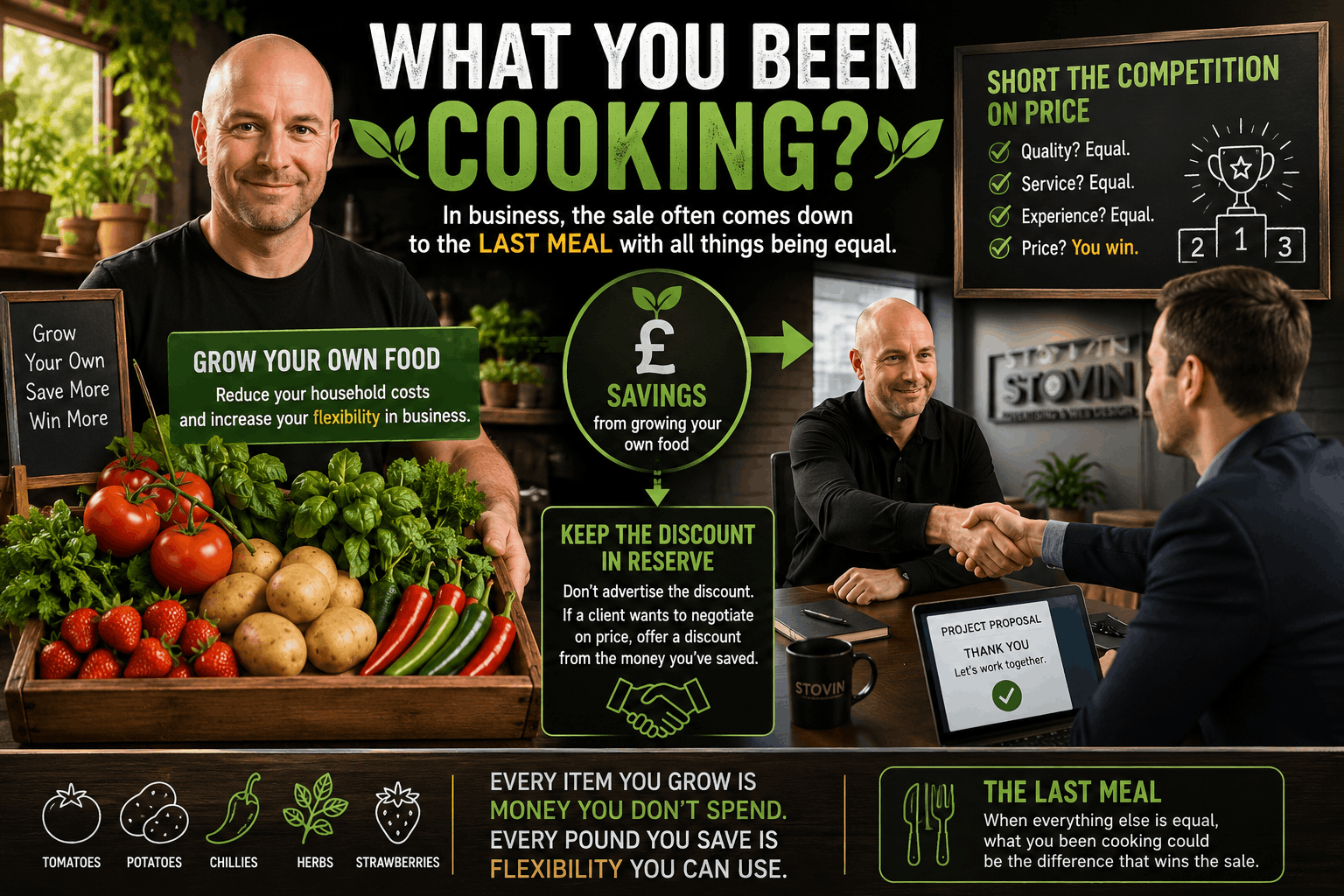
Grow Your Own Food, Reduce Your Costs
Growing some of your own food—whether that’s tomatoes, potatoes, chillies, strawberries, herbs or salad—can reduce a small part of your household spending.
Those savings might not seem significant individually, but the principle is important: the less money you need to spend elsewhere, the more flexibility you can potentially have in business.
Think of it as creating your own little efficiency.
Keep the Discount in Reserve
Rather than advertising discounts and immediately competing on price, keep your normal prices intact.
If a prospective customer is happy with your company but price becomes the final obstacle, you then have room to negotiate.
For example, if you’ve saved £50 or £100 through growing food and reducing other household expenses, you could choose to effectively redirect that saving towards securing a worthwhile contract.
The customer receives a better deal without you having to advertise yourself as the cheapest company in the market.
Short the Competition on Price
In this context, “shorting the competition” means being able to come in slightly below a competitor when everything else is roughly equal.
Imagine two agencies competing for the same £5,000 project. Both have strong portfolios, both can deliver the work and the customer likes both companies.
Then comes the final conversation:
“Can you do anything on the price?”
That’s when your hidden flexibility becomes useful.
Instead of permanently lowering your advertised prices, you might negotiate a modest reduction to close the deal—provided the project remains profitable.
The Last Meal
That’s the idea behind “What You Been Cooking?”
Sometimes the sale comes down to the last meal. Every potato, tomato or chilli you’ve grown represents a small expense you didn’t have to meet elsewhere.
Growing your own food isn’t going to transform the economics of a business on its own. But combined with keeping overheads under control, it represents a useful business philosophy:
Save where you can. Charge what your work is worth. Keep some negotiating room in reserve.
And when everything else between you and the competition is equal, perhaps what you’ve been cooking gives you just enough flexibility to win the sale.


