
The Tuppence Exchange: Turning a girls tuppence Into a Strawberry Runner
What if a tuppence wasn’t simply spent, but exchanged for something that can grow?
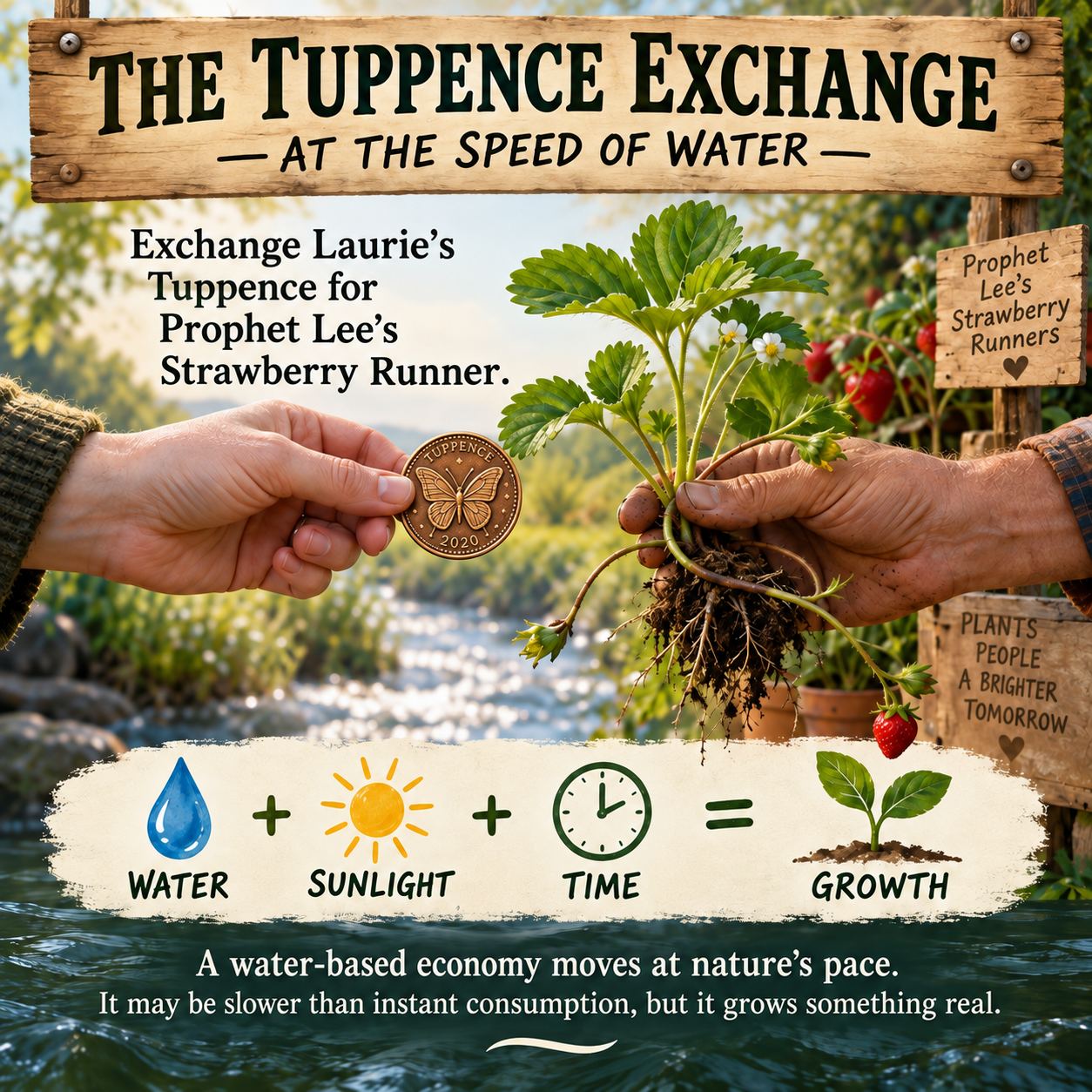
That is the idea behind The Tuppence Exchange — At the Speed of Water. Laurie’s Tuppence is exchanged for one of Prophet Lee’s strawberry runners. Instead of receiving another disposable product, the person receives a living plant that can be put into soil, watered and allowed to develop.
Water + Sunlight + Time = Growth
A strawberry runner illustrates a simple principle:
WATER + SUNLIGHT + TIME = GROWTH
Once established, a strawberry plant can produce strawberries and send out new runners. Those runners can potentially be replanted or passed on to somebody else.
The original exchange therefore represents more than the immediate value of the tuppence. It represents putting a small resource towards something productive.
An Exchange at Nature’s Pace
Modern economies are built around speed. We buy something, consume it and often replace it.
Plants operate differently. You cannot pay a strawberry plant to produce its fruit tomorrow. It needs suitable soil, water, sunlight, nutrients and—most importantly—time.
That is what “at the speed of water” represents in the Tuppence Exchange: accepting that useful growth can be gradual.
From Tuppence to Strawberries
The exchange can become a simple cycle:
Tuppence → strawberry runner → planting → water and sunlight → strawberries → more runners → another exchange.
It doesn’t replace ordinary money or the wider economy. Instead, it’s a small-scale example of how exchanging, growing and sharing useful resources can complement conventional spending.
A tuppence might be small. A strawberry runner is small too. But given the right conditions, a living plant can grow beyond what was originally exchanged.
THE TUPPENCE EXCHANGE — AT THE SPEED OF WATER
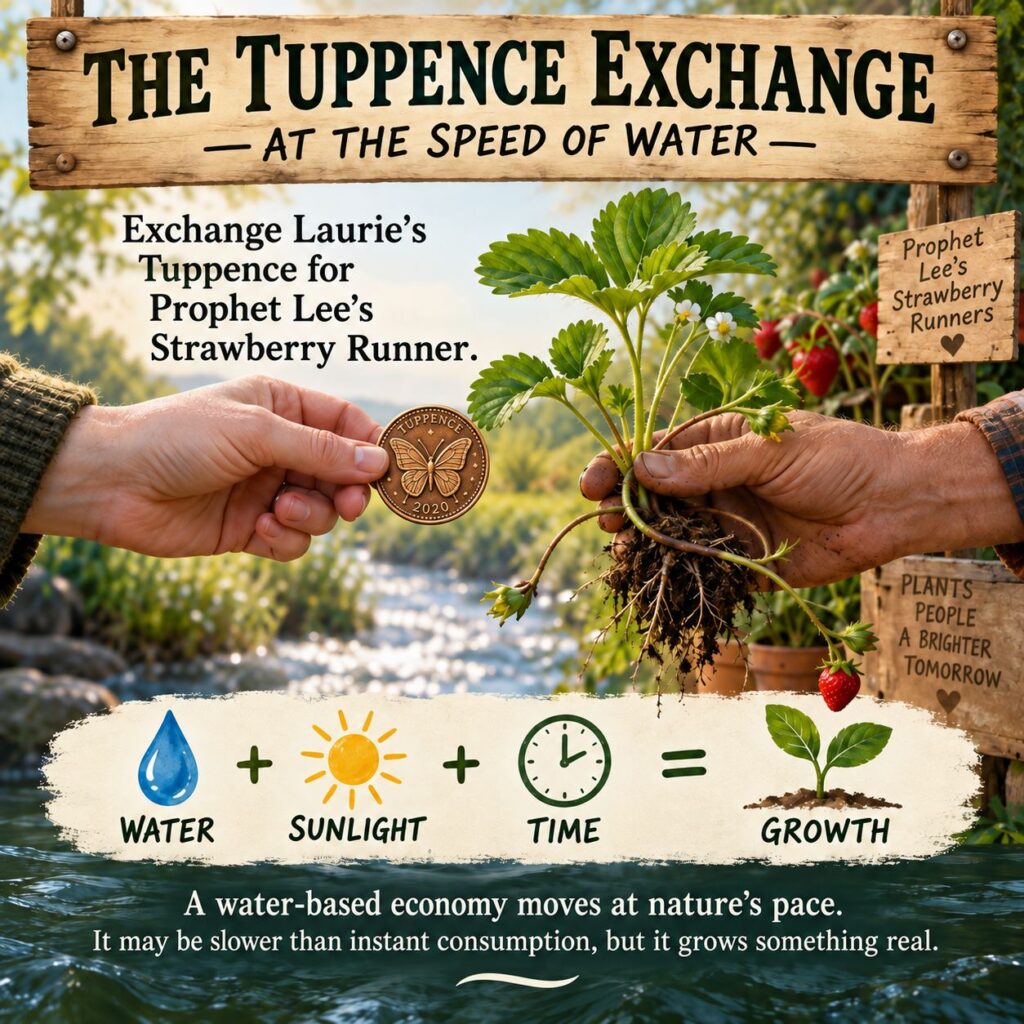
Exchange Laurie’s Tuppence for Prophet Lee’s strawberry runner.
Water + Sunlight + Time = Growth.
A water-based economy is slower — but it grows something real.


