
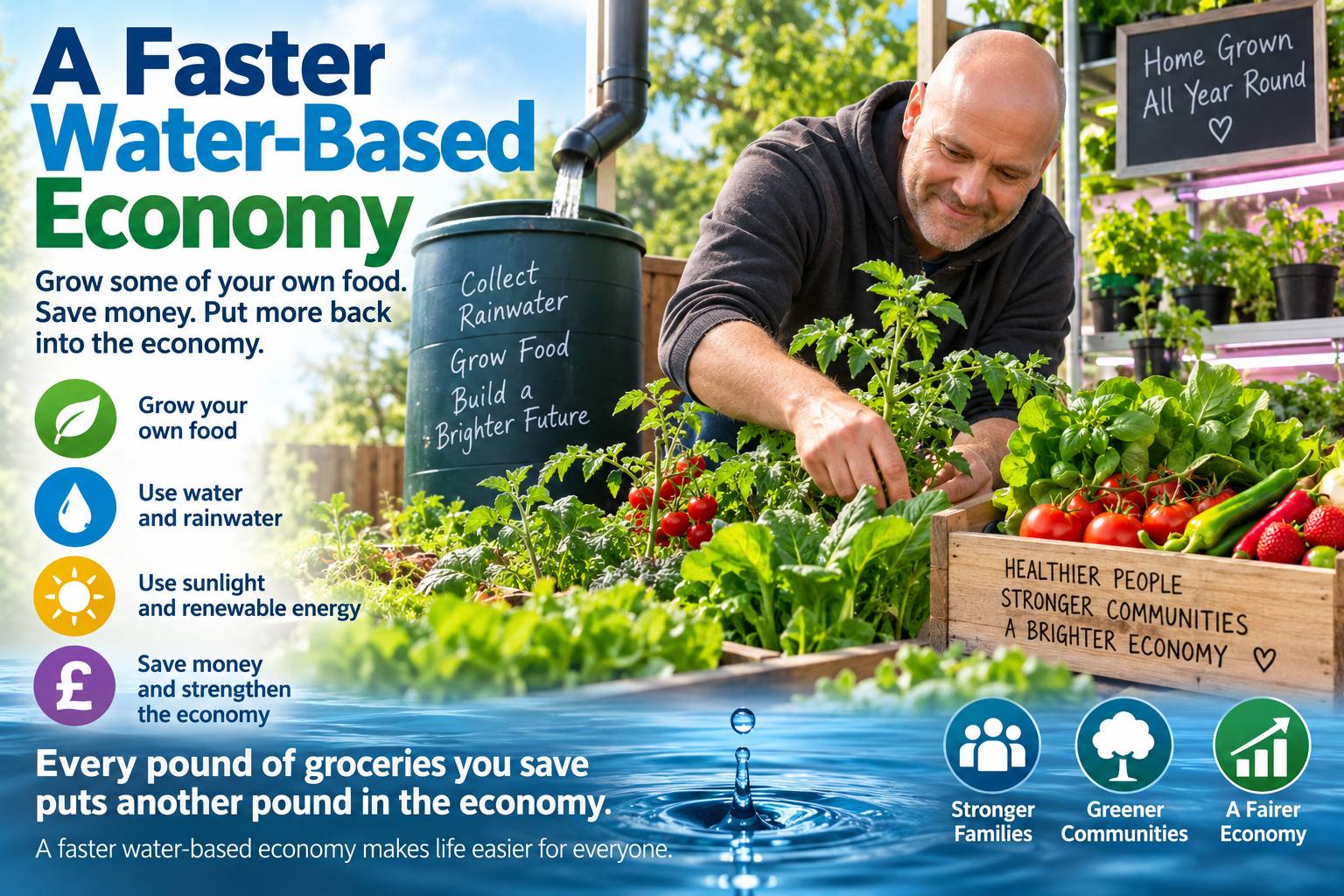
We Need a Faster Water-Based Economy
A water-based economy is about using renewable resources, growing more of what we need and reducing the amount of money households have to spend on everyday essentials.
One of the simplest places to start is growing some of your own food.
You don’t need a farm or a huge garden. Herbs, chillies, tomatoes, salad leaves, strawberries and other foods can be grown at home. During the summer we can make use of natural sunlight, while grow lights can extend the growing season indoors during darker months.
Save on Food, Free Up Money
Think about the household economy. If you grow £10 worth of food that you would otherwise have bought from a supermarket, that’s potentially £10 you can keep for something else.
That money hasn’t magically created another £10 for the wider economy, but it has reduced your household’s dependence on purchased food and freed some of your budget for other needs.
Multiply that idea across thousands or millions of households and it could make families more resilient to increases in food prices.
We Need to Implement Water Faster
The challenge isn’t simply a shortage of money. We also need to become better at using the resources already around us.
Water helps us grow food. Sunlight provides energy. Rain can potentially be collected and used for gardens where local rules and conditions allow. Renewable electricity can power grow lights and other equipment.
Instead of thinking only about consuming more, we can think about producing more of life’s essentials ourselves.
The faster households become productive, the easier the transition could become.
Start Small and Keep Growing
A water-based economy doesn’t require everyone to become completely self-sufficient.
Start with a windowsill.
Grow some herbs. Try a chilli plant. Plant tomatoes in summer. If you have a garden, gradually dedicate more space to food. Learn what works and improve each year.
Every successful crop means a little less that needs to be bought.
Water Means Growth
Oil powered much of the industrial economy. A more sustainable future can increasingly rely on renewable electricity, sunlight, water and efficient local production.
The goal isn’t to stop spending altogether. It’s to reduce unnecessary dependence on finite resources and expensive supply chains while freeing household income for the things people still need to buy.
Grow some of your own food. Save some money. Use resources efficiently. Then put those savings where they can improve your life.
That’s the idea behind a faster water-based economy.


